

Indonesia is the largest country in Southeast Asia and also home to its largest railway network. Predominantly located on the island of Java, Indonesia’s railways are benefiting from significant local and regional investment, cementing their place in the country’s long-term infrastructure plans.
Indonesia is a country constantly on the move, with significant investment underway to improve and expand its railway network. The region’s first high-speed railway line is already up and running on the island of Java and there are plans to extend it even further towards Surabaya and Banyuwangi.
Although the rest of the country has historically fallen behind Java in terms of investment, there are signs the government is recognising the strategic importance of railways, which should in turn lead to a better-connected country in the coming decades.
Disclaimer: This website contains affiliate links. Should you click to purchase, it is at no additional cost to you, but we receive a small commission.
Have questions? Join the Southeast Asia Trains Facebook Group.
Guides to Indonesia train routes
Our guides to Indonesia’s most popular train routes are listed below. Each guide includes train timetables, ticket prices and other practical information.
How to buy tickets
Click here to book Indonesian train tickets.
The easiest way to buy train tickets in Indonesia is online rather than going to the station. You do pay a very small commission but the ease and convenience makes it worthwhile.
12Go is the best website to use and accepts international credit cards. It's also a good place to check timetables and prices.
After booking online you'll receive a confirmation email with a QR code and booking number. You'll need to exchange this for an orange boarding pass via one of the self-service machines at the station before travel. This can be done up to seven days in advance at any station in the country (it doesn't need to be the one you're departing from). You may also need to show your passport or ID at the boarding gate, but this isn't usually enforced.

Java’s railway network
Stretching to almost 5,000km of track, Java’s railway makes up the vast bulk of the country’s network and is where the majority of investment and improvement works are taking place. Covering a large part of the island and linking most of the major towns and cities, it’s the best way to explore Java.
The major cities are all on the railway network, with Jakarta, Yogyakarta and Surabaya among the most popular destinations for overseas travellers. Mainlines on the network include:
- Jakarta to Surabaya via Yogyakarta
- Jakarta to Bandung
- Bandung to Surabaya via Yogyakarta
- Malang to Banyuwangi and Ketapang
In addition to the standard railway lines, a new high-speed line opened in 2023 linking Jakarta with Bandung. There are plans to extend this to Surabaya, plus a separate new fast mainline from Jakarta along the north coast.
Java is also home to a growing mass-transit railway system in Jakarta, Surabaya and Bandung.
If you’re intending to head over to one of the neighbouring islands, the trains are also a good option here. The port towns of Merak and Banyuwangi are on the railway network and have onward ferry connections to Sumatra and Bali respectively.
High-speed line from Jakarta to Bandung
By far the most exciting development in Indonesia’s recent travel history is the introduction of the Chinese-built high-speed line from Jakarta to Bandung. With trains capable of running at 350km/h, the journey time has been slashed to only 45 minutes (albeit to the outskirts of town).
Onboard the accurately-named Whoosh trains are VIP, Business and Economy class carriages, with air-conditioning, reclining seats, power points and trolley service.
Although these new trains are hugely welcome and have revolutionised train travel on the island, it’s disappointing that their stations are such a long way from the city centres (40 minutes by public transport), negating one of the most common advantages of train travel over air travel: easy access to city centres. Most travellers board or disembark at Padalarang and take the free shuttle to/from Bandung station.

Train travel in the rest of the country
Sumatra and Sulawesi also have railway lines, although neither network matches the scale or investment of Java.
Sumatra has a couple of lines in operation in Aceh, North Sumatra, West Sumatra and South Sumatra. The most useful line for travellers is the one that links the South Sumatran city of Palembang to Bandar Lampung, from where it’s only a short distance to reach the port and catch a ferry to Merak in Java (and then on to a commuter train to Jakarta).
Sulawesi has an even smaller network, with only one line currently in operation.
Future plans for the network
With both China and Japan keen to stay involved in Indonesia’s development plans, it seems highly likely that more high-speed rail will be built in the country. This will almost certainly include extending the Jakarta – Bandung line to Surabaya, plus an entirely new fast line (probably not technically ‘high-speed’) along the north coast, also terminating at the port city of Surabaya.
One day in the distant future, a high-speed line may even run all the way from Jakarta to Ketapang on the east coast of the island, only a short ferry ride from Bali. This will need a huge amount of political effort and goodwill to accomplish, but it would completely revolutionise travel within Indonesia.
Elsewhere, there are extensive plans across the country to expand the network by 2030, linking more of the islands together and improving existing services, particularly on the island of Sumatra. There’s little doubt that Indonesia is one of the most forward-thinking countries in Southeast Asia when it comes to train travel, and it’s almost certain that investment will continue to flow.

What to expect on board Indonesian trains
Indonesian trains are modern, comfortable, (usually) punctual and well-maintained. Increasing numbers of carriages are being upgraded from Economy to Premium Economy, providing comfier seats and better onboard facilities. Stations are well organised too, with friendly staff on hand to assist you before departure, information boards, waiting rooms, shops, cafes and helpful ticket offices.
Once onboard, most travellers choose either Executive or Economy class as they offer the best combination of comfort and affordability. Executive class carriages are cleverly designed with rotatable seats, so you’ll be forward-facing (or you can spin one pair around to make a group of four if you’re travelling with friends or family). They also have a generous amount of legroom, more than enough for even the tallest traveller to sit back and relax, and you won’t feel guilty about reclining your seat.
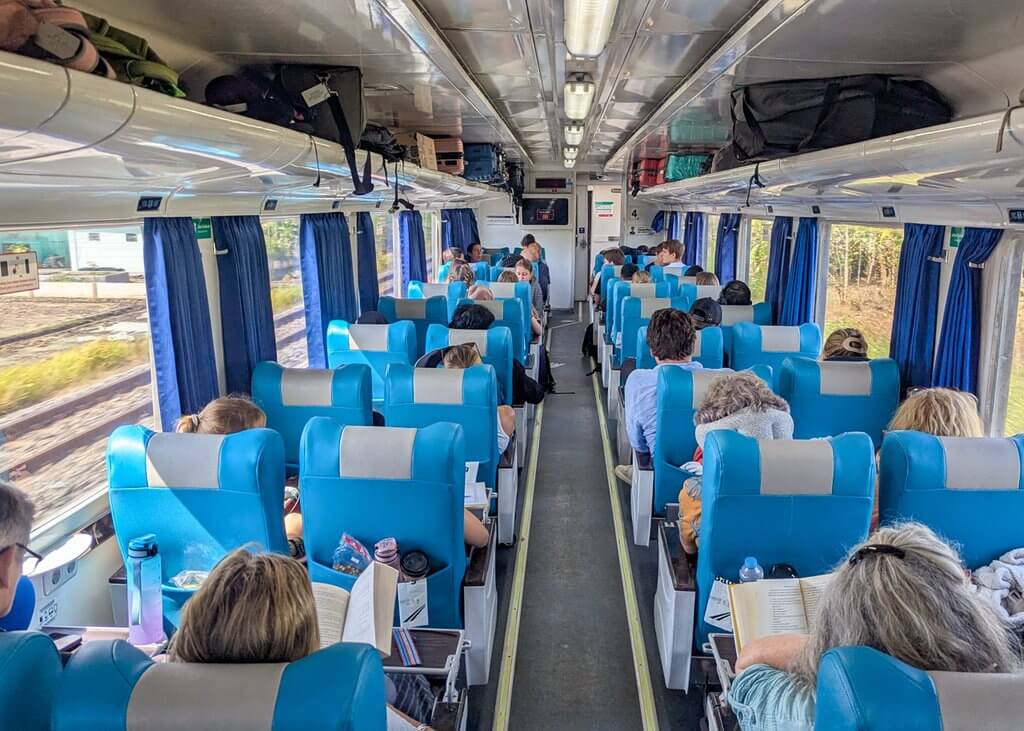
Economy class is still a good choice and many travellers choose this option to save some money. The two main areas where it falls short of Executive are legroom and upkeep. Firstly, a few extra rows of seats have been wedged into the carriage, leaving only a few inches of extra legroom. If you’re over 6ft tall, you might need to squeeze in and prepare for a tight ride, particularly if the person in front of you reclines their seat. Secondly, the carriages themselves are slightly less well maintained than the Executive ones, so you miss out on some of the comfort and premium feel, although the Premium Economy carriages have helped alleviate some of these problems.
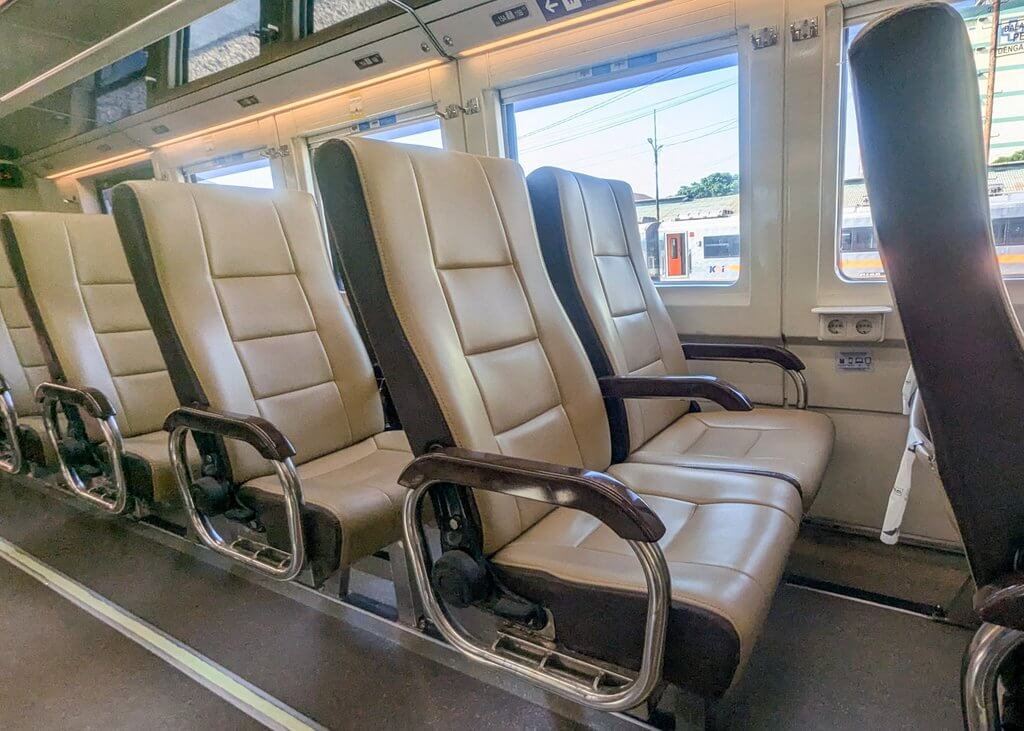
Both Economy and Executive carriages are fully air-conditioned and have power points, seat pockets, armrests and tray tables. Typically the trains will be made up of four Executive carriages and four (Premium) Economy carriages. There’s also a catering car, more on that below.
On some trains, particularly between Jakarta and both Surabaya and Yogyakarta, additional carriages offer an extra level of luxury, including Compartments and Panoramic. Although these are significantly more expensive, they do offer a fantastic experience, whether that’s the uninterrupted views in Panoramic class, or the (almost) lie-flat seats and privacy of Compartment class.
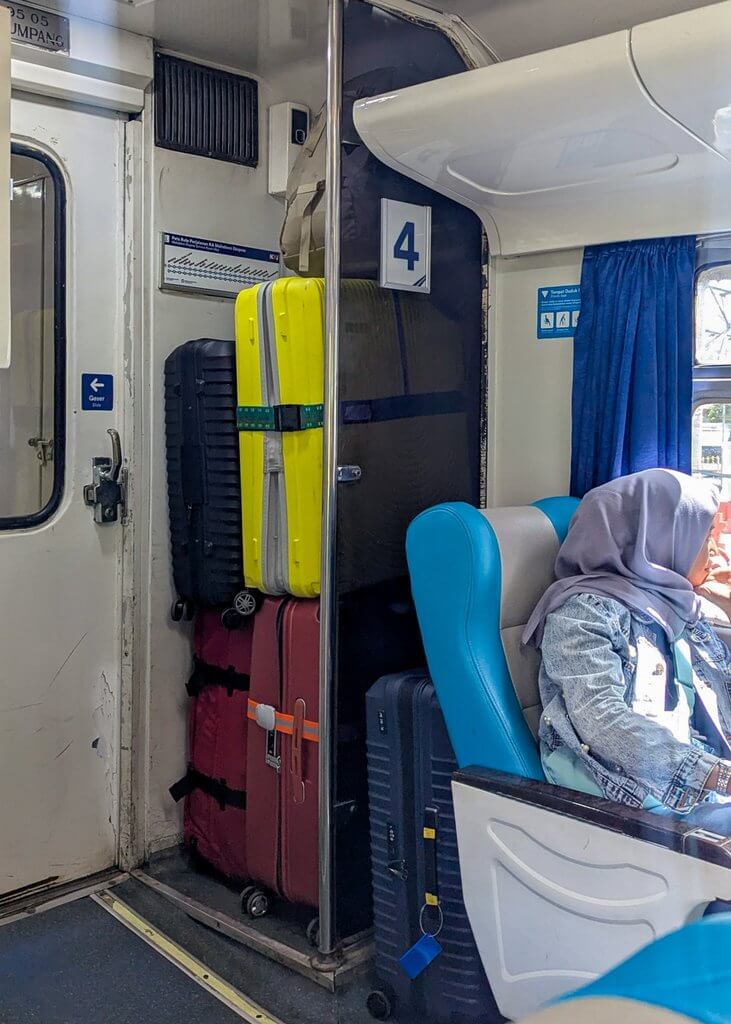
Luggage storage is the same in both classes but life will be significantly easier if you’re travelling with backpacks or smaller, soft suitcases. Many tourists board the train with huge rigid suitcases that don’t fit into the overhead racks, so there’s sometimes a battle to squeeze these cases into the luggage racks at the end of the carriage. It delays boarding and blocks the aisles, so do try and reduce your luggage size if at all possible. Technically, each passenger is allowed 20kg, and this is often enforced if you’re obviously exceeding the limits.
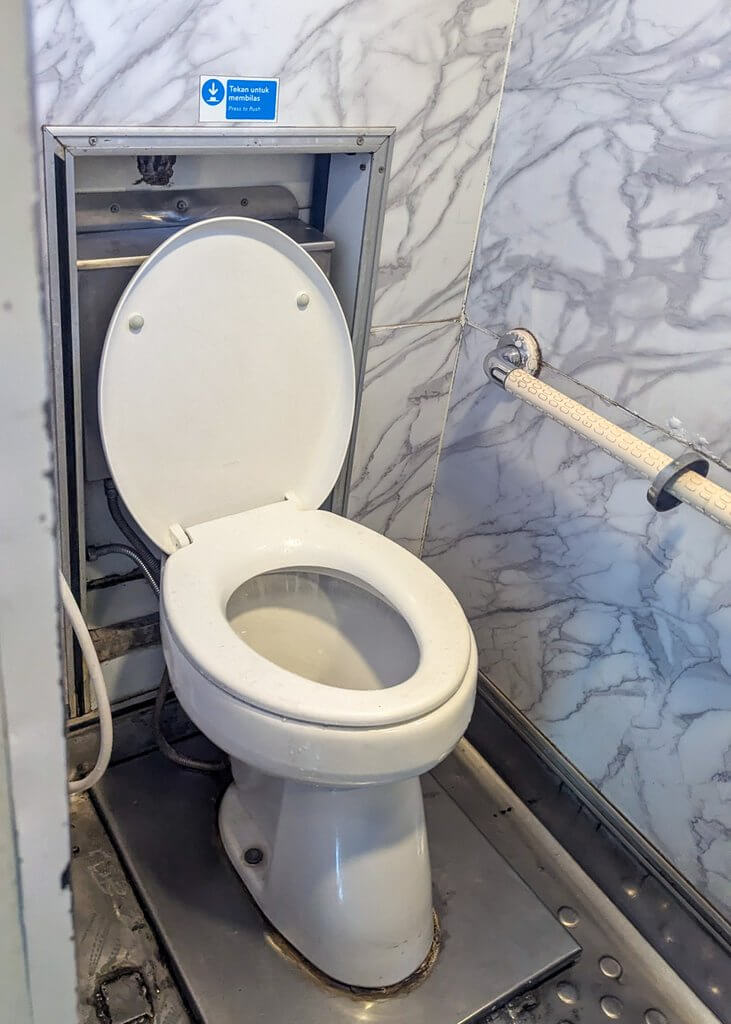
Toilets are located at the end of each carriage, with either Western-style or ‘squat-and-drop’, depending on the train and class you’re travelling in. Economy tends to have both types, Executive is usually Western-style only, and has separate male and female toilets. The toilets in both classes are cleaned regularly and kept in decent condition.
Most trains have a combination of a restaurant carriage and a catering trolley, both of which offer the same options (noodles, tea/coffee, crisps, soft drinks, etc). If you get the chance, it’s much nicer to eat in the restaurant car with its sociable atmosphere and comfortable tables and chairs. Payment is either by cash or e-wallets (QRIS) but it’s common for the stock levels to run low towards the end of all longer journeys, especially the hot meals and soft drinks.
Tips for Indonesian trains
- Book daytime trains if possible; many of the routes offer some of the best views in Southeast Asia, especially between Central and East Java.
- Executive class is usually worth the extra expense, particularly for journeys over three hours.
- Whoosh high-speed trains feel extra-special and exhilarating, but be aware your journey will begin and end a long way from Jakarta and Bandung. Follow everyone else and use the free shuttle train between Padalarang and Bandung.
- Book tickets online and remember to print out your orange boarding passes from the self-service machines before going through the departure gates.
- Trains are a popular way to explore Indonesia, particularly around the tourist hotspots of Yogyakarta, Surabaya and Malang. In peak tourist season, try to book as far in advance as possible.
- Make your life easier by packing as lightly as possible, ideally with soft backpacks.
Useful reads before you go:
Top tips for Southeast Asia train travel
Reasons why you should travel by train around Southeast Asia
The BEST train journeys in Southeast Asia
10 essentials experienced travellers always take on trains in Southeast Asia
Book your train travel:
If you have found this website useful for planning your Southeast Asia train travel, you can show your support by buying me a coffee. Thanks so much!
