

Only a few hours from Bangkok, Hua Hin is a popular beach destination for locals and foreigners alike. After relaxing on the beach and exploring the town’s sights, bars and restaurants, many visitors return to the capital by minivan or bus, but the smoothest option is taking one of several daily trains.
Disclaimer: This website contains affiliate links. Should you click to purchase, it is at no additional cost to you, but we receive a small commission.
Have questions? Join the Southeast Asia Trains Facebook Group.

Route map and details
The vast majority of the services from Hua Hin to Bangkok arrive at Krung Thep Aphiwat Central Terminal. Two trains also use Hualamphong (one of them only on weekends and public holidays), plus two Ordinary trains each day to Thonburi.

Timetables
Click here to check all Thailand train times
Hua Hin to Krung Thep Aphiwat Central Terminal
There are nine trains per day from Hua Hin to Bangkok’s Krung Thep Aphiwat Central Terminal, most of which depart at fairly brutal times in the middle of the night. These trains have originated in the south of Thailand and are scheduled to arrive into Bangkok first thing in the morning, hence the inconvenient timings from Hua Hin.
SP40, departing Hua Hin in the mid-afternoon is, unsurprisingly, the most popular service on this route.
| Train | Hua Hin | Krung Thep Aphiwat |
|---|---|---|
| SP44 | 00:14 | 03:45 |
| RP168 | 01:26 | 05:10 |
| EX86 | 02:20 | 06:10 |
| EX84 | 03:07 | 07:05 |
| RP172 | 03:51 | 07:30 |
| SP32 | 04:27 | 08:10 |
| SP38 / SP46 | 05:17 | 09:05 |
| RP170 | 06:40 | 10:50 |
| SP40 | 14:36 | 18:05 |
Hua Hin to Hualamphong
There’s also one daily train from Hua Hin to Bangkok’s Hualamphong station, plus an Excursion train that runs on weekends and public holidays:
| Train No. | Hua Hin | Hualamphong |
|---|---|---|
| 262 | 14:56 | 19:20 |
| 9121 | 16:38 | 20:15 |
1 Weekends and public holidays only
Hua Hin to Thonburi
Two Ordinary trains run each day from Hua Hin to Bangkok’s Thonburi station:
| Train No. | Hua Hin | Thonburi |
|---|---|---|
| 252 | 06:14 | 10:30 |
| 254 | 12:47 | 17:25 |

How to buy tickets
The easiest way to buy train tickets in Thailand is online rather than going to the station. You do pay a very small commission but the ease and convenience makes it worthwhile in our opinion.
Baolau is the best site to use for buying train tickets, they have access to the live Thai Railways booking engine, so you can easily see availability, timetables and prices.
Payment can be made using international credit cards and PDF confirmation tickets are sent to your email address within a few minutes. This is the actual ticket you need to board the train, so there’s no need to exchange it at the station before travel. You may prefer to print the pdf out, but it’s also fine to show it on your mobile phone to the conductors and station staff.
Hua Hin to Bangkok train tickets
If you’re planning to take the Ordinary or Excursion train to Hualamphong or Thonburi, you should buy tickets at the station on the day of travel.
For the long-distance trains to Krung Thep Aphiwat Central, tickets can be booked online or at the station. Keep in mind that because these trains are travelling long-distance from the south of the country, priority is given to passengers buying tickets for journeys that are more than 60% of the entire route.
As Hua Hin to Bangkok is only a relatively short distance, tickets for this trip are generally only available 24 hours in advance (or at the station on the day of travel).
How much does it cost?
On the Hua Hin to Bangkok train, you have several different classes to choose from, although our recommendation is either a second class berth (AC) or second class seat:
| Train | 1st class berth (AC) | 2nd class berth (AC) | 2nd class seat | 3rd class seat |
|---|---|---|---|---|
| SP44 | – | – | ✓1 | – |
| RP168 | – | ✓2 | ✓ | ✓ |
| EX86 | ✓ | ✓ | ✓ | ✓ |
| EX84 | ✓ | ✓ | ✓ | ✓ |
| RP172 | – | ✓ | ✓ | ✓ |
| SP32 | ✓ | ✓ | – | – |
| SP38 | ✓ | ✓ | ✓ | ✓ |
| SP46 | – | ✓ | – | – |
| RP170 | – | ✓ | ✓ | ✓ |
| SP40 | – | – | ✓1 | – |
| 262 | – | – | – | ✓ |
| 912 | – | – | – | ✓ |
| 252 | – | – | – | ✓ |
| 254 | – | – | – | ✓ |
1 Air-conditioned carriages
2 Non-AC berths also available
The approximate prices for each class are:
| Class | Cost (THB) |
|---|---|
| First class berth (A/C) | 900 – 1200 |
| Second class berth (A/C) | 600 – 800 |
| Second class seat (A/C) | 300 – 400 |
| Second class seat | 200 – 250 |
| Third class seat | 80 – 100 |
What to expect on board
All of the daily trains departing to Thonburi or Hualamphong will have third-class carriages only. Seating varies on these trains but will usually just be hard wooden benches, although you might get lucky and have padded seats. All of the carriages are fan-only (no air-conditioning) but the windows can (and will) be fully opened by other passengers.

Many tourists discover they actually enjoy the slightly austere conditions on third-class trains and remember them fondly. It’s relatively cool when the train is moving (and become too breezy), but it does quickly get hot again when the train is stationary. The four and a half journey time from to Bangkok is probably the maximum amount of time you’d spend on a hard seat before the novelty begins to wear off.
Long-distance trains offer a mixture of first, second and third-class carriages, with either seats or sleeper berths.
First-class sleeper compartments are the most expensive option and also the hardest to book, due to the small number available on this route. They’re popular with overseas tourists who place a premium on privacy and some added comfort. Whenever we’ve used them, we’re always grateful that the lights and air-conditioning are adjustable for each compartment as they can both be overpowering in second-class. The first-class carriages also have their own toilet and washing facilities, and are a step up from the second-class versions.
The only downside to first-class (aside from the cost) is that it can feel less sociable than second-class but is definitely worth considering if you prefer your own space. It’s also possible to book the entire compartment (also known as a ‘room’ on the Thai booking engine) if you’re prepared to pay for the privilege.
Note that it will be very hard to book first-class carriages on this route. They’re only available on the trains travelling from the far south of the country, so you can only book them 24 hours before travel. It’s highly likely that other travellers will have booked the first-class sleeper by the time they go on sale for you.
Second-class carriages are less private than first class, although each berth does have its own privacy curtain so you won’t be on display during the night. During the day, berths are configured as upright seats facing each other, making for a pleasant space to relax. However, as all of the sleeper trains depart Hua Hin in the middle of the night, you won’t have much opportunity to enjoy sit upright as the majority of the journey will be pre-dawn.
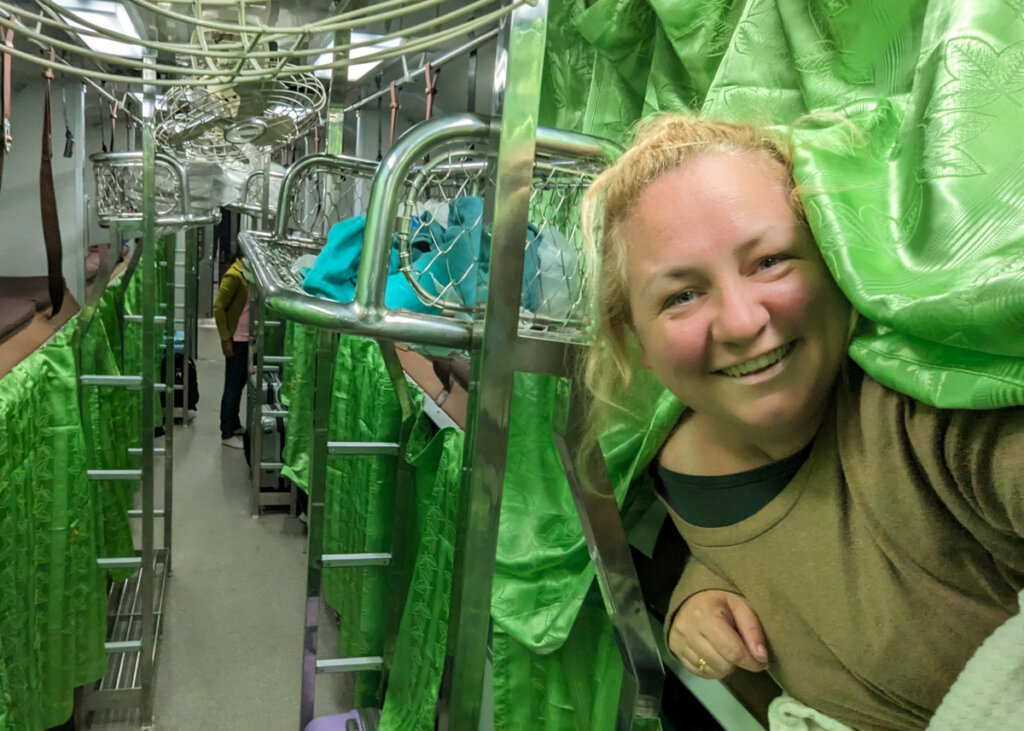
Lower berths are the most popular, mainly because they have the window and are slightly wider. They’re also much easier to access than the upper berth, which requires some effort to navigate the ladder and confined space. Upper berths don’t have a window and are more affected by the bright ceiling lights that stay on for the duration of the journey. One common complaint about Thai sleeper trains are these bright lights, and you’re in full glare on the top bunk. An eye mask is a great addition to your luggage.
What are the toilets and wash facilities like?
First-class carriages have excellent facilities, sometimes even featuring a hot shower on the newer carriages. As there are only a few first-class compartments on each train, you won’t normally need to wait and the staff keep them clean and tidy, with soap and toilet paper stocked up.
In the rest of the train, the toilets are also kept in decent condition, perhaps not as fancy as in first-class but more than good enough for the duration of the journey. Many people worry about using the toilets on trains but the ones in Thailand are nearly always well looked-after, so there’s nothing to worry about. It does make sense to bring your own toilet paper and hand-sanitiser though, just in case.
Toilets on the third-class trains from Hualamphong and Thonburi are more basic, but still usable for this length of journey.
Catering options
A restaurant car is attached to the train for the journey, serving cheap and reliable Thai meals, but due to the middle of the night departure from Hua Hin, you won’t get any chance to use it.
Food and drink vendors would normally walk up and down the train offering meals, snacks and drinks, but even they won’t be working during the dead of night. Make sure you bring your own supplies on the sleeper trains, you’ll have more luck on the Ordinary trains during the day.
Journey description
Hua Hin is directly on the Gulf of Thailand coast and the train stays fairly close to the sea during the first couple of hours of the trip. Unfortunately you won’t see much of the scenery if you’re on the sleeper trains, but the Ordinary trains during the day will give you some glimpses of the attractive scenery.
After reaching Nong Pladuk Junction, the train heads east towards Bangkok’s city centre, branching off to either Hualamphong, Thonburi or Krung Thep Aphiwat in the final few kilometres.
Useful reads before you go:
Top tips for Southeast Asia train travel
Reasons why you should travel by train around Southeast Asia
The BEST train journeys in Southeast Asia
10 essentials experienced travellers always take on trains in Southeast Asia
Book your train travel:
If you have found this website useful for planning your Southeast Asia train travel, you can show your support by buying me a coffee. Thanks so much!
