

Surat Thani is an attractive city in its own right, but most travellers only use it as the gateway to even more beautiful destinations. If you’re in Bangkok and heading south to places such as Phuket or Koh Samui, it’s likely Surat Thani will be on your radar.
Easily accessible by several daily services, taking the train from Bangkok to Surat Thani is a popular, affordable and memorable part of any trip to Thailand.
Disclaimer: This website contains affiliate links. Should you click to purchase, it is at no additional cost to you, but we receive a small commission.
Have questions? Join the Southeast Asia Trains Facebook Group.
Route map and details
The journey from Bangkok’s Krung Thep Aphiwat station to Surat Thani takes nine or ten hours, with sleeper carriages available on most services.
You’ll notice that the arrival timings aren’t particularly convenient, with many of the trains arriving between 1.00am and 5.00am. This is because Surat Thani isn’t the terminus for most of these train routes, and the majority of them are carrying on into southern Thailand to destinations including Hat Yai and Padang Besar on the border with Malaysia.
As a result, the final three departures of the day from Bangkok (EX85, RP167, SP39) that arrive at more sensible times tend to be the most popular and difficult to book.

Timetables
Click here to check all Thailand train times
There are eleven trains per day from Bangkok to Surat Thani, all of which have sleeper carriages apart from SP43 and SP39.
| Train | Bangkok | Surat Thani |
|---|---|---|
| SP43 | 07:30 | 16:20 |
| RP171 | 15:10 | 01:11+1 |
| SP37 | 16:10 | 01:49+1 |
| SP45 | 16:10 | 01:49+1 |
| SP31 | 16:50 | 02:20+1 |
| RP169 | 17:30 | 04:06+1 |
| EX83 | 18:50 | 04:58+1 |
| EX85 | 19:50 | 06:23+1 |
| RP173 | 20:10 | 06:46+1 |
| RP167 | 20:30 | 07:16+1 |
| SP39 | 22:50 | 07:50+1 |
Average journey time: 9 hours 56 minutes

How to buy tickets
The easiest way to buy train tickets in Thailand is online rather than going to the station. You do pay a very small commission but the ease and convenience makes it worthwhile in our opinion.
Baolau is the best site to use for buying train tickets, they have access to the live Thai Railways booking engine, so you can easily see availability, timetables and prices.
Payment can be made using international credit cards and PDF confirmation tickets are sent to your email address within a few minutes. This is the actual ticket you need to board the train, so there’s no need to exchange it at the station before travel. You may prefer to print the pdf out, but it’s also fine to show it on your mobile phone to the conductors and station staff.
Bangkok to Surat Thani train tickets
How much does it cost?
There are several classes to choose from on the Bangkok to Surat Thani train, although our recommendation is a second-class berth (AC):
| Train | 1st class berth (AC) | 2nd class berth (AC) | 2nd class seat | 3rd class seat |
|---|---|---|---|---|
| SP43 | – | – | ✓ 1 | – |
| RP171 | – | ✓ | ✓ | ✓ |
| SP37 | ✓ | ✓ | ✓ | ✓ |
| SP45 | – | ✓ | – | – |
| SP31 | ✓ | ✓ | – | – |
| RP169 | – | ✓ 2 | ✓ | ✓ |
| EX83 | ✓ | ✓ | ✓ | ✓ |
| EX85 | ✓ | ✓ | ✓ | ✓ |
| RP167 | – | ✓ 2 | ✓ | ✓ |
| SP39 | – | – | ✓ 1 | – |
1 Air-conditioned carriages
2 Non-AC berths also available
The prices for each class are:
| Class | Cost (THB) |
|---|---|
| First-class berth (A/C) | 1370 |
| Second-class berth (A/C) | 720 – 1010 |
| Second-class seat (A/C) | 520 |
| Second-class seat | 350 – 440 |
| Third-class seat | 210 – 300 |
What to expect on board
Two of the services (SP39 and SP43) only have seated carriages, the rest have a combination of first and second-class berths, plus third class seats. Special Express 43 is a pleasant option if you’d prefer travelling during daylight hours and to see some of the view along the way.
Second-class air-conditioned carriages are comfortable, with tray tables, reclining seats and charging points. They work well during the day but it can be difficult to get much sleep on the overnight train. For that reason, Special Express 39, which departs at 10.50pm and arrives at 7.50am, is something of an endurance test and not really recommended.
Third-class seats should only be considered if there’s no alternative and you must travel there and then. Ten hours on a hard seat (especially overnight) is one Southeast Asian train journey you’ll remember for all the wrong reasons.
First-class sleeper compartments are the most expensive option and also the hardest to book, due to the small number available on this route. They’re popular with overseas tourists who place a premium on privacy and some added comfort. Whenever we’ve used them, we’re always grateful that the lights and air-conditioning are adjustable for each compartment as they can both be overpowering in second-class. The first-class carriages also have their own toilet and washing facilities, and are a step up from the second-class versions.
The only downside to first-class (aside from the cost) is that it can feel less sociable than second-class but is definitely worth considering if you prefer your own space. It’s also possible to book the entire compartment (also known as a ‘room’ on the Thai booking engine) if you’re prepared to pay for the privilege.
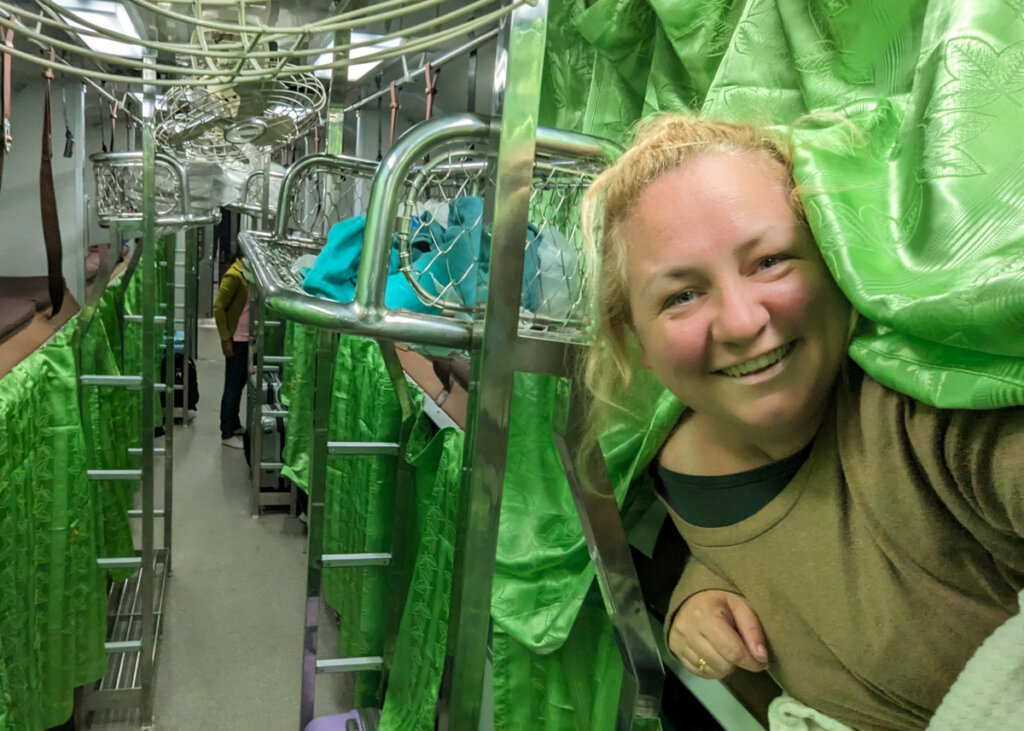
Second-class carriages are less private than first class, although each berth does have its own privacy curtain so you won’t be on display during the night. During the day, berths are configured as upright seats facing each other, making for a pleasant space to relax, especially if you’re travelling with someone. Sometime around 7.00pm, attendants will make their way down the carriage and convert the seats into berths, ready for sleeping.
Lower berths are the most popular, mainly because they have the window and are slightly wider. They’re also much easier to access than the upper berth, which requires some effort to navigate the ladder and confined space. Upper berths don’t have a window and are more affected by the bright ceiling lights that stay on for the duration of the journey. One common complaint about Thai sleeper trains are these bright lights, and you’re in full glare on the top bunk. An eye mask is a great addition to your luggage.

What are the toilets and wash facilities like?
First-class carriages have excellent facilities, sometimes even featuring a hot shower on the newer carriages. As there are only a few first-class compartments on each train, you won’t normally need to wait and the staff keep them clean and tidy, with soap and toilet paper stocked up.
In the rest of the train, the toilets are also kept in decent condition, perhaps not as fancy as in first-class but more than good enough for the duration of the journey. Many people worry about using the toilets on trains but the ones in Thailand are nearly always well looked-after, so there’s nothing to worry about. It does make sense to bring your own toilet paper and hand-sanitiser though, just in case.


Catering options
A restaurant car is attached to the train for the journey, serving cheap and reliable Thai meals. Although they might not look great in their plastic boxes and served from a slightly makeshift kitchen area, the meals are usually excellent quality and never too expensive. They’re definitely a step up from crisps and biscuits you see many other travellers consuming.
It’s convenient and sociable to eat in the restaurant car but if you’d rather stay at your berth, train staff also walk up and down the carriage with a menu, offering to bring meals to you. A small tip is appreciated if you use this service.
As this is Thailand, there’s never a shortage of food and drink vendors walking along the train offering meals, snacks and drinks. Expect to pay around THB40 – 120 for a meal and THB20 for soft drinks.
Alcohol is prohibited on all Thai trains and there are fines if you’re caught drinking.
Journey description
All the trains heading to Surat Thani now leave from Bangkok’s Krung Thep Aphiwat station, which is modern and functional but nowhere near as romantic or evocative as Hualamphong Station, which was the main station in town until a few years ago.
Heading west out of the city and suburbs, the train takes the Southern Line passing through Hua Hin and Chumphon, gliding through the central provinces of the country, close to the Gulf of Thailand.
Surat Thani is a major gateway to southern Thailand, particularly the tourist islands of Koh Samui, Koh Phangan and Phuket. Onward travel can either be arranged in Bangkok before you depart or when you arrive in Surat Thani. Whatever the time of day or night, scores of tourist touts will be on hand to help you on your way. Keep your wits about you and go with the flow.

Useful reads before you go:
Top tips for Southeast Asia train travel
Reasons why you should travel by train around Southeast Asia
The BEST train journeys in Southeast Asia
10 essentials experienced travellers always take on trains in Southeast Asia
Book your train travel:
If you have found this website useful for planning your Southeast Asia train travel, you can show your support by buying me a coffee. Thanks so much!
