

Chiang Mai is one of the most visited cities in Thailand, a gateway to a region that’s home to breathtaking mountain ranges, Buddhist temples, nature treks and a world-class food scene. It feels a world away from the exciting chaos of Bangkok but it’s still well-connected to the capital by several convenient daily train services.
High levels of tourist traffic between the two regions means it’s always peak season on the railways, so it’s best to book tickets in advance where possible. We’ve collected together all the information you’ll need, including route guides, timetable information and the best place to book tickets.
If you’re planning to travel further around Thailand by train, our Thailand train travel guide covers the country’s main railway routes, Bangkok’s stations, train classes, booking tickets and what to expect on board.
Disclaimer: This website contains affiliate links. Should you click to purchase, it is at no additional cost to you, but we receive a small commission.
Have questions? Join the Southeast Asia Trains Facebook Group.
Route map and details
Chiang Mai and Bangkok are the start and end points of Thailand’s Northern Line. Although there are plenty of tourist stops along the way, most passengers on this route are travelling between the two cities.
Thailand’s state railway company has long been aware that the Northern Line is bursting at the seams and in need of expansion and maintenance. This large scale infrastructure project has already made tentative progress in double-tracking and electrifying the line, which will lead to increased capacity and reliability in the long-term.
But for now, you should expect to find most services running at 90%+ capacity and sleeper berths hard to come by. Book in advance where you can, especially if travelling in a group or as a family, or if you want a first-class compartment.
Timetables
Click here to check all Thailand train times
There are five trains per day from Chiang Mai to Bangkok. Sleeper carriages are available on all trains apart from RP102 (non-AC service, second and third class seats) and SP8 (second-class air-conditioned seats).
SP10 and SP14 are the most popular trains and should be booked as far in advance as possible, particularly in peak tourist season and around religious festivals.
| Train | Chiang Mai | Bangkok |
|---|---|---|
| RP102 | 06:25 | 20:05 |
| SP8 | 07:30 | 17:40 |
| EX52 | 15:30 | 05:10 |
| SP14 | 17:05 | 05:55 |
| SP10 | 18:20 | 06:30 |
Average journey time: 12 hours 30 minutes

How to buy tickets
The easiest way to buy train tickets in Thailand is online rather than going to the station. You do pay a very small commission but the ease and convenience makes it worthwhile in our opinion.
Baolau is the best site to use for buying train tickets, they have access to the live Thai Railways booking engine, so you can easily see availability, timetables and prices.
Payment can be made using international credit cards and PDF confirmation tickets are sent to your email address within a few minutes. This is the actual ticket you need to board the train, so there’s no need to exchange it at the station before travel. You may prefer to print the pdf out, but it’s also fine to show it on your mobile phone to the conductors and station staff.
Chiang Mai to Bangkok train tickets
How much does it cost?
The Chiang Mai to Bangkok train usually has four different classes to choose from, ranging from a private first-class berth for two people, to a hard, uncomfortable third-class seat. Most tourists book a second-class berth and it’s our recommended way to travel from Chiang Mai to Bangkok.
Here is a list of which class is available on which train:
| Train | 1st class berth (A/C) | 2nd class berth (A/C) | 2nd class seat | 3rd class seat |
|---|---|---|---|---|
| RP102 | – | – | ✓ | ✓ |
| SP8 | – | – | ✓ 1 | – |
| EX52 | – | ✓ | ✓ | ✓ |
| SP14 | ✓ | ✓ | ✓ | ✓ |
| SP10 | ✓ | ✓ | – | – |
1 Air-conditioned carriages
Prices for each class are shown in the table below, note that some trains have newer carriages so the prices are sometimes slightly higher:
| Class | Cost (THB) |
|---|---|
| First-class berth (AC) | 1500 |
| Second-class berth (AC) | 850 – 1000 |
| Second-class seat (AC) | 560 |
| Second-class seat | 380 – 470 |
| Third-class seat | 270 – 320 |
What to expect on board
The daytime trains (Special Express 8 and Rapid 102) are seating carriages only. SP8 has air-conditioned second-class carriages that make for a much more comfortable journey than Rapid 102, which has second and third-class carriages, but fan only. Second-class carriage on these trains have tray tables, reclining seats and charging points. Third-class carriages are hard seats or benches; authentic and memorable, but not for the entire thirteen hours.

Choosing the sleeper option means you’ll be trading views for convenience, as the overnight trains save you a night’s accommodation bill, plus the journey seems to pass by much more quickly when you’ve slept for a large proportion of it. As you can see from the timetables above, all the later sleeper trains arrive into Bangkok before 7.00am, so factor that into your decision.
First-class compartments (available on SP10 and SP14) are popular with those tourists who place a premium on privacy. An added advantage is the ability to control the lighting and air-conditioning, which are both usually set too high in the second-class carriages. The first-class carriages also have their own toilet and washing facilities, and are a step up from the second-class versions. It’s also possible to book the entire compartment (also known as a ‘room’ on the Thai booking engine) if you’re prepared to pay for the privilege.
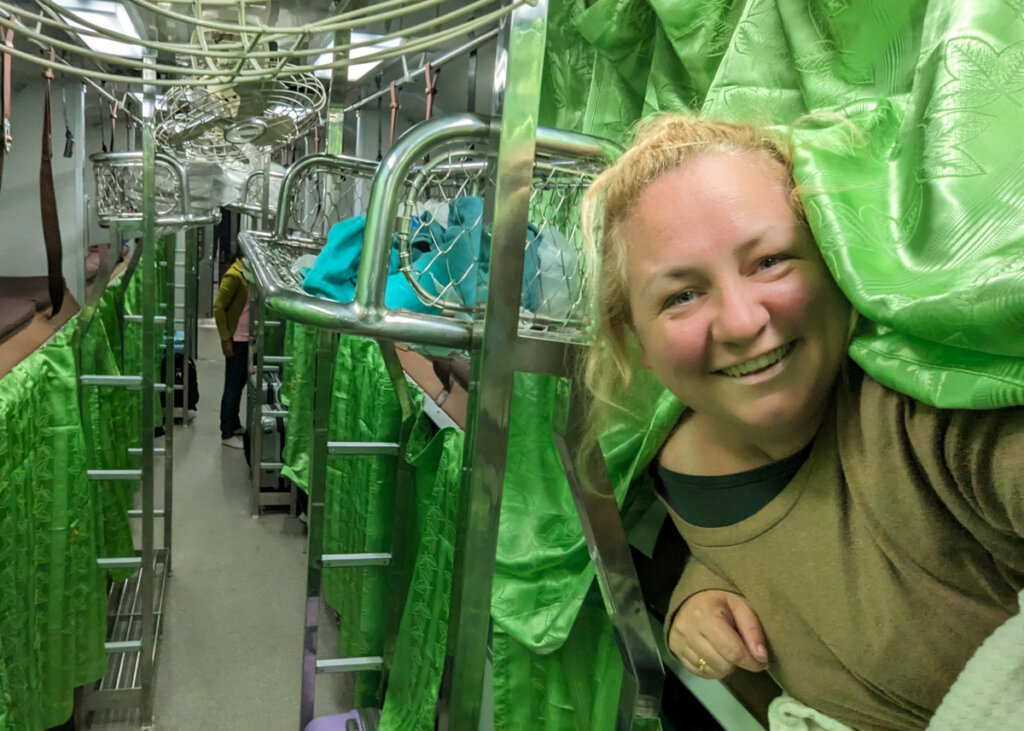
Second-class sleeper carriages are open-plan but each berth has a privacy curtain. The berths are setup as pairs of seats facing each other during the day, before being converted into beds around 7.00pm. If you’re travelling as a group of two or four people and manage to get berths next to each other, it’ll feel private but still sociable.
Lower berths are the most popular, mainly because they have the window, are slightly wider, and are easier to get in and out of. Upper berths don’t have a window and are more impacted by the bright lighting that’s left on for the entire journey. You also have to be quite agile to climb up the tiny metal ladder to access them. If you have the choice, the extra money is well spent on the lower berth.

Thai trains use a Type A, B and C plug (two flat parallel pins), so don’t forget your travel adapter. We also recommend packing a compact power bank just in case power points aren’t available.

Most of the sleeper services also have non-AC carriages, either second or third-class. The second-class carriages have comfortable reclining seats similar to the AC carriages, but rely on open windows for ventilation. It can get very breezy inside the carriage when the train is at full speed, making the journey cooler but also a bit more of an endurance test.
What are the toilets and wash facilities like?
First-class toilets are kept in first-class condition and you’ll find them neat and tidy throughout the journey. Some of the newer carriages even have a hot shower available.
Although somewhat cramped, the second-class toilets are kept clean throughout the journey and there always seems to be enough toilet-paper, although it’s always best to carry your own. Each carriage has its own pair of toilets, one Western-style and one ‘squat-and-drop’.
Two sinks are also located at the end of carriage, providing space for washing hands and brushing teeth. It’s not five-star luxury but more than adequate for a quick clean-up before bedtime.


Catering options
A restaurant car is attached to the train for the journey from Chiang Mai to Bangkok. It’s a popular place for travellers to meet up and swap stories, although it’s quieter than it was before the alcohol ban. Don’t be put off by the uninspiring plastic menus and photos of the food, when it arrives it’s actually excellent quality and tasty.

If you’d prefer to stay at your seat, you can either order from train staff who walk up and down the train (they’ll bring your meal to your seat when it’s ready, tips appreciated), or from the food vendors who board the train throughout the journey. Expect to pay around THB40 – 120 for a meal and THB20 for soft drinks.
Alcohol is prohibited on all Thai trains and there are fines if you’re caught drinking.
Journey description
Northern Thailand offers the most attractive scenery in the entire country, so you should prepare for stunning vistas as you depart Chiang Mai, especially for the first few hours. If you’re up for the early start and a less comfortable journey, RP102 (and to an extent, SP8) captures sunrise and the mountainous views in their best light.
Thailand’s Northern Line is undergoing significant work to expand capacity and you’ll see evidence of this during the journey, particularly around Lop Buri and Ayutthaya, both of which are popular tourist destinations in their own right. The countryside views recede as you approach the outskirts of Bangkok, with the train threading its way through the suburbs and industrial areas until the famous city skyline become visible.
Krung Thep Aphiwat is a modern, functional and fairly uninspiring place to end your journey from Chiang Mai, but it’s very good at processing arriving passengers with the minimum of fuss. Only a short Grab or MRT ride away from the city centre, the station won’t be the most memorable part of your trip but it shouldn’t cause you any issues either. Once you’re out of the station, enjoy a few days exploring Bangkok before continuing your Thai railway adventures, perhaps heading south to the islands via the overnight sleeper train to Surat Thani?

Useful reads before you go:
Top tips for Southeast Asia train travel
Reasons why you should travel by train around Southeast Asia
The BEST train journeys in Southeast Asia
10 essentials experienced travellers always take on trains in Southeast Asia
Book your train travel:
If you have found this website useful for planning your Southeast Asia train travel, you can show your support by buying me a coffee. Thanks so much!
