

The railway network is an integral part of life in Thailand, stretching thousands of kilometres from Bangkok to all parts of this beautiful country. Thai trains are the iconic way to experience Thailand, offering comfort, value for money, and lifelong memories.
Riding the rails in Thailand is one of travel’s great adventures. Falling asleep in a sleeper berth as the Thai countryside rolls by is an experience you’ll long remember and, thanks to the thousands of kilometres of track radiating out from Bangkok, there’s no shortage of journeys to choose from.
Our Thailand train travel guide covers everything you need to know about travelling by train, from the main routes and Bangkok’s railway stations to booking tickets, train classes and what to expect on board. We’ve also included detailed guides to the most popular Thai train routes, helping you plan your journey and make the most of travelling around Thailand by rail.
Investment is ongoing throughout the network, with exciting plans to build high-speed rail to further connect and integrate the country into Southeast Asia’s (and China’s) growing transport network. For now, take a read through our Thailand train travel guide and start planning your next big trip.
Disclaimer: This website contains affiliate links. Should you click to purchase, it is at no additional cost to you, but we receive a small commission.
Have questions? Join the Southeast Asia Trains Facebook Group.
Guides to Thailand train routes
Our guides to Thailand’s most popular train routes are listed below. Each guide includes train timetables, ticket prices, and other practical information.
Whether you’re travelling north to Chiang Mai, south towards Surat Thani and the islands, or across the border into Malaysia, these are some of the most useful and popular train journeys in Thailand.

How to buy Thai train tickets
The easiest way to book Thai train tickets is online. You can check routes, timetables and availability before booking, and avoid having to visit a station in Thailand.
Ready to book?
Book Thai train tickets on the 12Go website
Or, use the form below to book using 12Go:
How far in advance can I book?
Thai train tickets can be booked up to 90 days in advance, although the booking window depends on how much of the train’s overall route you’re travelling.
For most travellers, this isn’t usually a problem. If you’re travelling between Bangkok and one of the main tourist centres, such as Chiang Mai, Surat Thani, or the borders with Malaysia or Laos, you’re likely to be travelling a large part of the route and can book up to 90 days ahead.
If you’re only travelling a short section of a train’s route, however, the booking window can be much shorter:
| How much of the route you’re travelling | Booking window |
|---|---|
| More than 60% | 90 days in advance |
| 25% – 60% | 30 days in advance |
| Less than 25% | 1 day in advance |
Bookings can currently be made for travel until:
- More than 60% of route: 10th January 2027
- 25% – 60% of route: 11th November 2026
- Less than 25% of route: 13th October 2026
Bangkok’s railway stations
Bangkok has two main railway stations: Krung Thep Aphiwat Central Terminal (known as KTW) and Hua Lamphong. KTW is the newer station and has largely replaced Hua Lamphong as the main departure and arrival point for Bangkok, although some services do still use Hua Lamphong.
Krung Thep Aphiwat Central Terminal is the largest railway station in Southeast Asia and although it has none of the charm or ambience of Hua Lamphong, it’s certainly efficient, well planned and easy to navigate.

Main train routes in Thailand
Thailand has one of the most extensive railway networks in Southeast Asia, stretching over 4,000km and reaching into all four corners of the country. The major tourist centres are linked directly to Bangkok, and there are trains heading to neighbouring Laos, Cambodia and Malaysia.
The four main train routes in Thailand are:
- Northern Line
- Northeastern Line
- Southern Line
- Eastern Line
Northern Line
Running from Bangkok’s Krung Thep Aphiwat Central Terminal, the Northern Line is the second longest in the country. Its principal line is the one running from Bangkok to Chiang Mai, with a small branch line travelling to and from Sawankhalok.
As the line is predominantly single track and not yet electrified, capacity is severely stretched, limiting the number of services that can travel along what is the busiest route in the country. As a result, services tend to be fully booked, especially around festivals, public holidays and weekends.

Northeastern Line
Connecting Bangkok with the country’s vast northeast region (known as Isan), the Northeastern Line is made up of three separate main lines:
- Ubon Ratchathani Main Line, heading to the large city of Ubon Ratchathani from Bangkok, uses the same route as the Northern Line for the first 90km before splitting off at Ban Phachi Junction.
- Nong Khai Main Line, travels to the border town of Nong Khai and then over the Thai-Lao Friendship Bridge into Laos and the capital city of Vientiane.
- Lam Narai Branch Line, a short branch line between Kaeng Khoi Junction and Bua Yai Junction
Southern Line
At over 1000km in length, the Southern Line is the longest in Thailand and connects many of the most popular tourist destinations to Bangkok, either directly or with a short onward bus connection. The main line is the Sungai Kolok Main Line, which runs from Bangkok to Sungai Kolok, close to the Malaysian border.
There are several other branch lines:
- Padang Besar Line, running to the Malaysian border
- Nam Tok Line, also known as the Death Railway, running from Nong Pladuk Junction to Nam Tok in Kanchanaburi.
- Kantang Line runs to Trang Province, close to some of Thailand’s Andaman islands.
- Nakhon Si Thammarat Line

Eastern Line
Of most use and interest to travellers on the Eastern Line will be the main line towards the Cambodian border, known as the Aranyaprathet Main Line. A smaller line travels towards Pattaya but, with only one train per day currently running, it’s limited, to say the least.
What are the Thai trains like?
Thai trains generally offer a comfortable, safe and authentic way of travelling around the country, allowing you to meet local people and travel on a budget. Although some of the rolling stock is showing its age, there is a constant investment and improvement programme on the network, with plans to introduce brand new carriages on high-speed lines in the near future.
Many long-distance services have air-conditioned sleeper carriages offering second-class berths, and sometimes a first-class carriage is added. Second-class berths are upper and lower bunks on either side of the corridor, with privacy curtains for when you go to bed.
During the daytime the berths are folded away, with the lower bunk forming a pair of facing seats with lovely views out of a wide window. It’s a very communal and memorable experience, ideal if you’re travelling in a group of two or four, but it works well for solo travellers too.
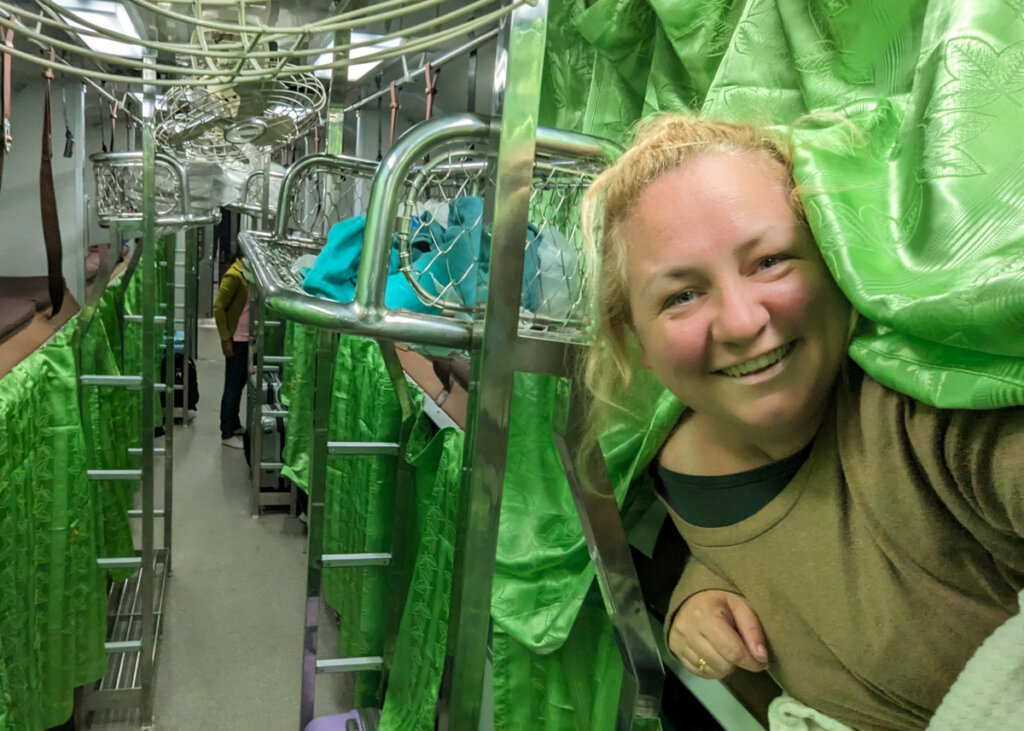
First class compartments are situated to the side of the corridor with lockable doors and two berths (upper and lower). There’s also a shared bathroom with the neighbouring compartment. While they offer more privacy and comfort, many travellers prefer second-class for the sociable aspect; it can feel as if you’re locked away from everyone in first class.
There will typically be a few carriages with normal seats, fine for a day journey but not recommended for overnight trips. The seats recline and have access to charging points, although the carriages can feel crowded. Luggage is stored either overhead or in the luggage racks at the end of the carriage.

There are also hundreds of Ordinary and Commuter trains criss-crossing the country every day, typically with third-class carriages only. While most visitors don’t use these trains, they’re a fun alternative for shorter daytime journeys and can be a highlight of your trip. Carriages are non-AC (electric fans only), although windows can be fully opened. When the train is moving, it’s breezy but the temperature is manageable.
Seating in the third-class carriage is a mixed bag, with hard wooden benches, plastic seats, or more comfortable padded seats. It’s a good chance to witness how most Thai people travel and worth trying at least once on your visit to Thailand. You’re most likely to use them on trips to Kanchanaburi or Ayutthaya.

Toilets on all trains are of the Western and squat-and-drop variety, usually quite clean (but less so towards the end of a long trip). Bring along some hand sanitiser and your own toilet paper, just in case.
Are Thai trains safe?
Yes, it does feel safe onboard, and it’s not uncommon to see police or ticket inspectors walking up and down the train during the journey. Petty theft isn’t unheard of, but it’s unlikely to be an issue for most travellers. Just take care to hide cash and valuables out of sight and consider investing in a simple padlock and tether to deter opportunistic thieves.
There are ongoing issues close to the borders with neighbouring countries, notably near Hat Yai and at the Cambodian border. Although tourists are rarely targeted, you should be aware of the risks and check with your own country’s advice regarding travel to these areas. The Thai authorities take the situation very seriously and security is a priority for them.
FAQs
Bookings open 90 days in advance for long distance trains, but only if you’re travelling for more than 60% of the route. For shorter journeys the booking window shrinks to 30 days or less.
Yes, tickets can be booked using the 12Go site where you can also check timetables and availability.
Krung Thep Aphiwat Central Terminal is now the main station in Bangkok, having taken over from Hua Lamphong in 2023. It’s the largest railway station in Southeast Asia and is practical, if a little soulless.
Not at the moment, although plans are in place to restart the service soon. For the time being, it only operates between Bangkok and Padang Besar (on the Malaysian border).
No, following a tragic incident in 2014, Thai authorities decided to ban alcohol on all Thai trains and there are fines if you’re caught drinking.
For the best combination of enjoyment, experience and value for money, choose a second-class berth on Thai trains. You won’t regret it.
Useful reads before you go:
Top tips for Southeast Asia train travel
Reasons why you should travel by train around Southeast Asia
The BEST train journeys in Southeast Asia
10 essentials experienced travellers always take on trains in Southeast Asia
Book your train travel:
If you have found this website useful for planning your Southeast Asia train travel, you can show your support by buying me a coffee. Thanks so much!
